Walker
A Radivive glossary entry. Scroll down for a plain-language definition and related terms in the same letter group.
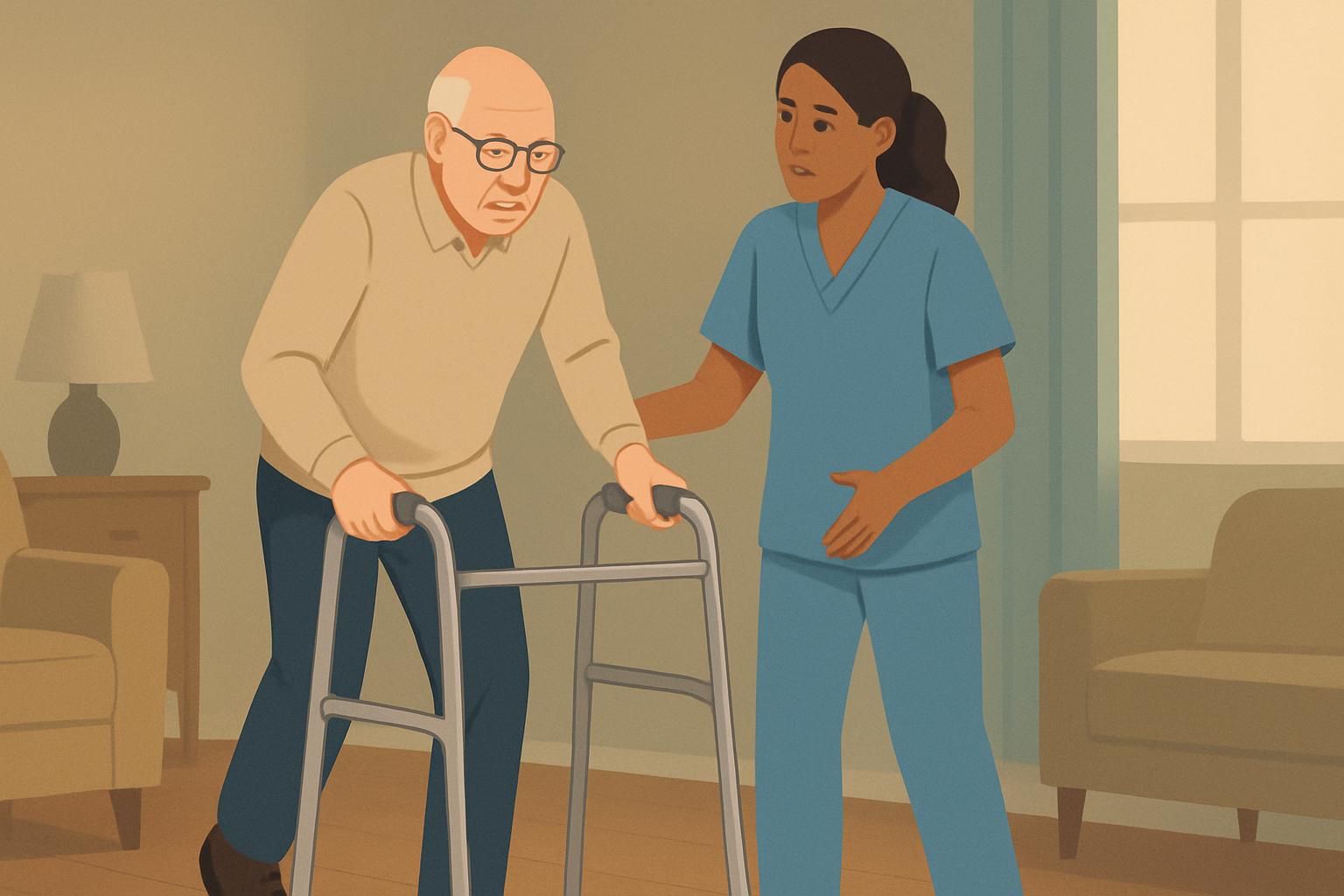
An illustration is not currently available for this term.
Definition
Definition
A walker is a medical mobility aid designed to provide support and stability for individuals who have difficulty walking independently due to injury, disability, or age-related functional decline. Distinct from other assistive devices such as canes or crutches, walkers offer a four-legged frame that users lift or roll forward to maintain balance and weight distribution while ambulating.
Origin and Background
The development of the walker emerged to address the need for improved mobility support among patients with reduced lower limb strength, balance impairments, or post-surgical rehabilitation requirements. Traditional walking aids like canes provided limited stability for certain populations, prompting the design of an apparatus that could distribute weight more evenly and reduce fall risk during ambulation.
⚡ Key Takeaways
- A walker functions as a four-legged support device enhancing balance and weight bearing during walking.
- Its primary use is to assist individuals in regaining or maintaining mobility safely, especially after injury or with mobility impairments.
- Walkers do not provide continuous support as some mobility devices do, requiring users to have a certain level of upper body strength and coordination.
- Understanding a patient’s physical capacity and environment is critical for selecting an appropriate walker and ensuring safe usage.
⚙️ How It Works
A walker operates by offering a stable frame that the user grips with their hands on each side. The user lifts or pushes the walker a short distance forward, stepping into or through its base to advance safely. Stability is enhanced by allowing partial weight bearing through the arms rather than exclusively on the legs. Factors influencing its effectiveness include the user’s upper body strength, balance, coordination, and the walker’s design features such as height adjustability, presence of wheels, or brakes. Health professionals evaluate mobility deficits and prescribe a walker with specifications matched to the individual’s needs, ensuring proper fit and training on use. The device is often combined with gait training and physical therapy to optimize safe ambulation.
Types or Variations
Established walker variations address different mobility requirements: standard walkers offer maximum stability with a fixed four-legged frame; wheeled walkers (two- or four-wheeled) facilitate smoother movement with reduced lifting, appropriate for users with more upper body strength; rolling walkers include braking mechanisms to control speed and enhance safety; seated or attendant-propelled walkers provide additional rest options or assistance; and specialized models accommodate uneven terrain or incorporate lightweight materials for portability. Selection depends on clinical assessment, user capability, and intended settings.
When It Is Used
Walkers are typically used during rehabilitation phase post orthopedic surgeries (e.g., hip or knee replacement), in managing chronic conditions that impair mobility (such as arthritis or neurological disorders), and to reduce fall risk in elderly populations with balance or muscle weakness. Physical therapists, occupational therapists, and physicians frequently evaluate patients to determine the need for walker use during mobility assessments. The device plays a role in treatment planning, functional evaluation, home environment modification, and ongoing safety monitoring within medical and caregiving contexts.
Example
A patient recovering from total knee arthroplasty may be prescribed a wheeled walker to initiate partial weight-bearing ambulation. Under supervision, the patient learns to grasp the walker’s handgrips, coordinate pushing the device forward while stepping, and controlling speed using the walker’s front-wheel brakes. This approach reduces fall risk, facilitates early mobilization, and supports gradual transition to independent walking as strength and balance improve.
Why It Matters
Correct identification and application of a walker directly influence patient safety, rehabilitation outcomes, and quality of life. Misuse or inappropriate selection can increase fall risk, cause strain or injury, and delay recovery. Proper use supports functional independence, reduces caregiver burden, and assists in maintaining physical activity levels critical for health. Documentation and communication about walker type, patient capability, and usage context are essential in clinical and caregiving environments to ensure consistent care and risk management.
⚠️ Common Mistakes
- Confusing a standard walker with a rolling walker and prescribing one unsuitable for the patient’s coordination or strength level.
- Using a walker without appropriate height adjustment, leading to poor posture, discomfort, or ineffective weight support.
- Failing to provide training or supervision, resulting in improper gait mechanics or increased fall risk.
Deeper Insight
While walkers increase stability, they simultaneously require users to possess sufficient upper body strength and cognitive coordination to operate safely, especially models that require lifting. This trade-off means a walker may be contraindicated when significant weakness or coordination deficits exist, necessitating alternative mobility aids or increased assistance. Additionally, environmental factors such as uneven surfaces or narrow pathways critically affect walker suitability and must inform device selection and patient education.
Related Concepts
- Canes – Single-point walking aids that provide less support and stability compared to walkers, suitable for minor balance issues.
- Crutches – Mobility devices that partially or fully offload the lower limbs, differing from walkers by requiring upper body strength to suspend body weight.
- Rollators – A type of wheeled walker with built-in seats and hand brakes, offering additional functionality for users who require rest breaks during ambulation.